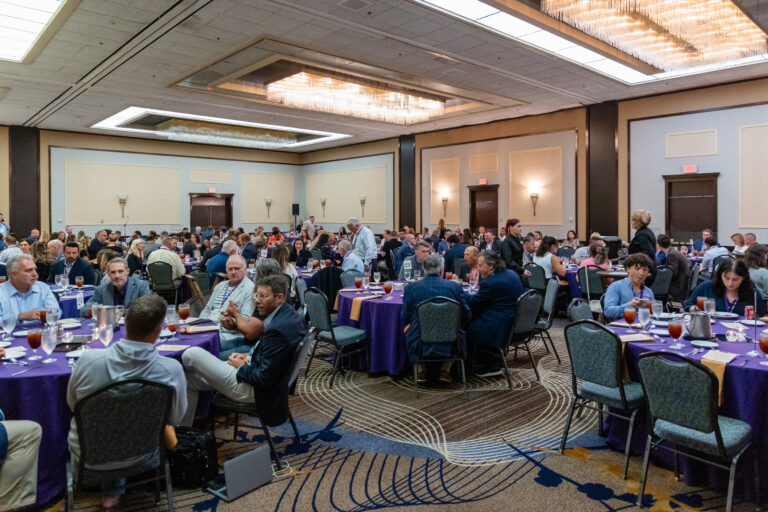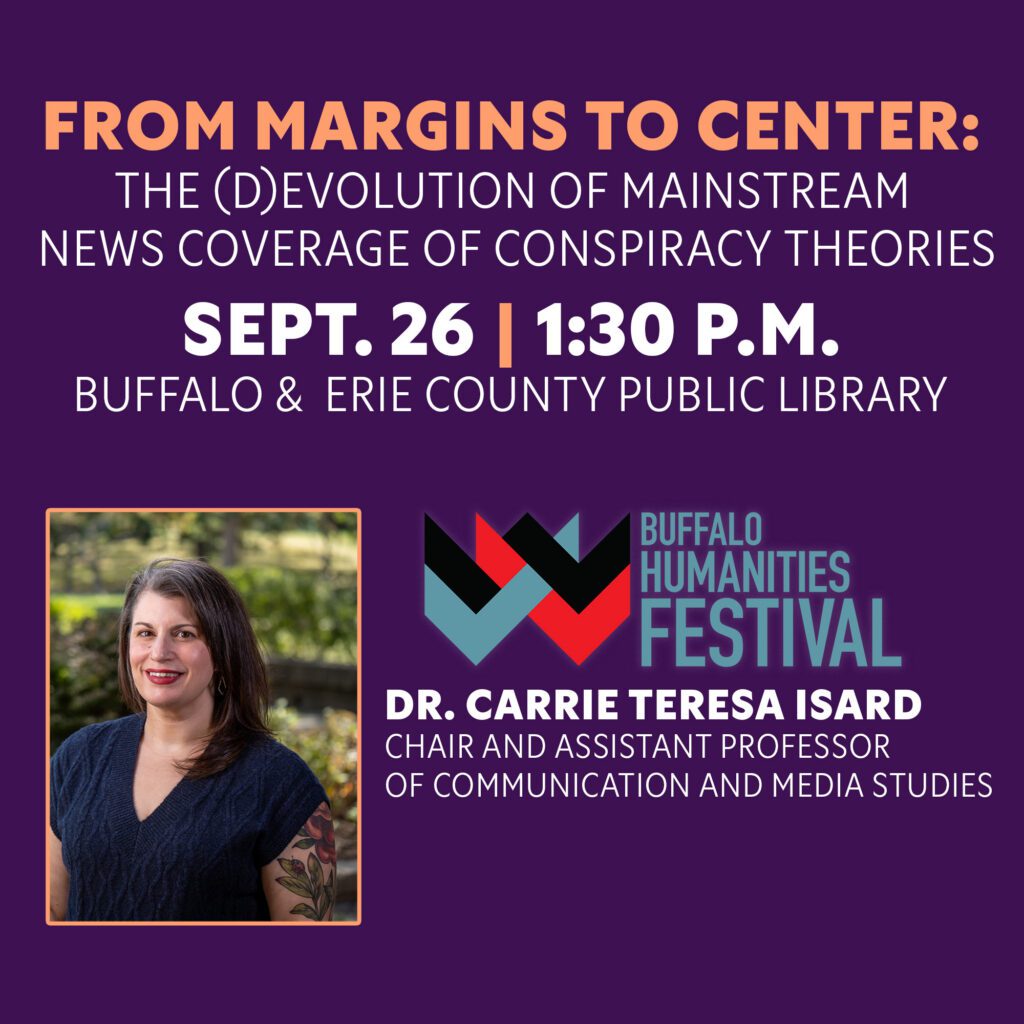
The Buffalo Humanities Festival will take place at the Buffalo & Erie County Public Library on Sept. 25 and 26. Dr. Carrie Teresa Isard, chair and associate professor of communication and media studies, will be giving a talk titled “From Margins to Center: The (D)evolution of Mainstream News Coverage of Conspiracy Theories.” The festival is free to attend and each year it partners with local universities and organizations to bring the community together in the name of celebrating art and ideas.
The theme for the Buffalo Humanities Festival this year is “Breaking News.” The festival is concerned about the rapid and seismic shift within media that has made being a news consumer so difficult. At a time with seemingly endless information, it has never been more difficult to feel informed about the world and one’s local community.
Dr. Isard understands that engaging with the humanities in the way the festival promotes, and the way they’re engaged with at Niagara University, is valuable. “The humanities are the things that teach us why life is worth living, as far as I’m concerned,” said Dr. Isard. “They teach us how to move through the world. They teach us how to appreciate art. They teach us how to appreciate each other. They teach us how to think critically and think creatively.”
Higher education strives to balance the difference between hard skills and soft skills. Hard skills are the ones needed to do the job. Many professions have strict requirements for hard skills because they can literally be the difference between life and death or breaking the law versus not breaking the law. It’s impossible to be a nurse just from analyzing “The Pitt.” If a student’s goal is to be a lawyer one day, “Better Call Saul” should not be their guide on how to be one, and writing a thesis on it won’t make them closer to being a lawyer. There is no getting past that development of hard skills is crucial in education, especially when following a specific professional track.
Dr. Isard said over her 12 years at Niagara, many students have come to her wanting to major in communication and media studies, but are concerned about career prospects and financial security. Students and families are focused on career outcomes and a return on their college investment, and no one can blame them for that. It’s the job of higher education institutions to show them that the foundational soft skills learned through humanities-based subjects are worthwhile and instrumental for developing a successful career.
Dr. Isard said, “I think my job as a professor is to teach students hard skills, right? To teach them hard, professional skills that are translatable in the marketplace. But it’s also to teach 18 to 21-year-olds how to move through the world with confidence, how to decide what they’re passionate about, how to decide how they’re going to represent themselves to the world, and how to have the confidence to do that.”
The pendulum may be swinging back in favor of the humanities, from a professional standpoint. The information available to everyone is becoming increasingly muddied. Determining what is real and what is fake has never been more difficult due to artificial intelligence (AI), and the role it has in professions is often automation or acceleration of the hard skills of a job. An individual’s ability to think critically and creatively, as well as an individual’s ability to relate to, and empathize with, others is already important in any form of work. These soft skills are only becoming more important as AI continues to progress.
Understanding oneself and understanding the culture around us provides intangible benefits. Dr. Isard began her interest in the humanities, specifically communication studies, because she wanted to apply the skills and strategies of English literature analysis to The Smashing Pumpkins.
Dr. Isard said, “Pop culture can sort of open doors to understanding culture and experience and art in ways that we don’t think about it, compared to how we think about canonical English literature.”
She chose to pursue what she was passionate about and sought to explore the meaning within. This pursuit of understanding culture and pursuing passion has led her where she is today. Every day she helps guide students on their personal and professional path, and now she is also bringing her area of research to the Western New York community in order to help develop media literacy and understanding of conspiracies and misinformation.
These issues can be seen every day, including the high-profile trial of Lindsay Clancy. Dr. Isard said, “That case ended in a mistrial. And no matter how you think about that case, you can’t deny the fact that the jurors were more than likely influenced by the glut of conspiracy theories that were circulating on social media.” Her point is not one of how the trial should have gone, rather, from the standpoint of media consumer, how could someone not be influenced by constant exposure to unsubstantiated conspiracies around it?
Dr. Isard’s talk centers on the defamation lawsuit the parents of Sandy Hook victims levied against former Infowars host Alex Jones. Jones peddled the conspiracy that Sandy Hook was a hoax, in service of a political agenda. Dr. Isard engages with this case and asks the broader question of how conspiracies have become so prevalent within mainstream news coverage.
This talk, the humanities festival, and Dr. Isard’s work as a whole are focused on how difficult it is to be an average consumer of news and media at a time where misinformation is so rampant, and becoming more difficult to identify every day.
The humanities provide the tools for sifting through this landscape. They provide the tools for self-discovery, developing empathy, and creating community. They provide tools for critical thinking, creativity, and understanding a world that is changing at an unprecedented speed.
Register to attend the Buffalo Humanities Festival, here.