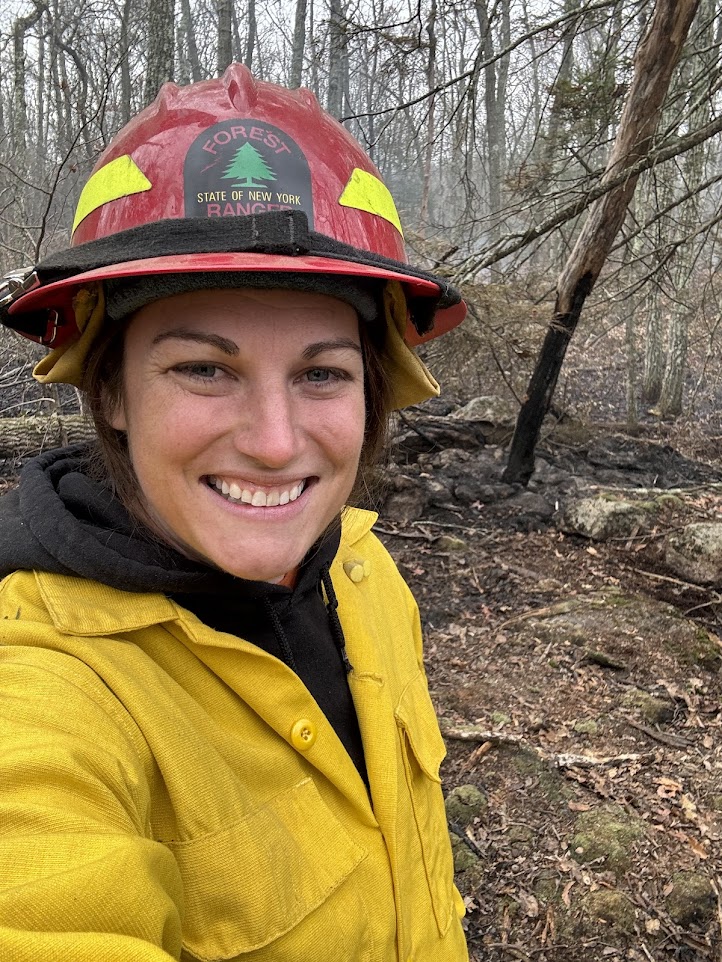
Erin (Baker) Hanczyk’s love for the outdoors led her to Lake Placid, N.Y., shortly after she graduated from Niagara University in 2011 with a degree in communications. She worked in a variety of industries before her “dream job” with theNYS Department of Environmental Conservation’s Division of Communication, Education, and Engagement became available. Today, asRegion 5 public participation specialist, Hanczyk serves as liaison between the organization and the public at community events, internal and external meetings, and other public outreach activities.
“I had been living in Lake Placid for about six or seven years,” she said, noting that, because she and her husband frequently hiked, fished, and hunted in the Adirondacks, she was “familiar with the DEC as an agency, with the forest rangers and everything they were doing to help conserve and protect the park that I loved so much.”
Hanczyk’s day-to-day work can include designing educational materials, working with the media, meeting with partner organizations and stakeholders, and organizing events. Another area of her job involves participating in search and rescues. Her first experience, which occurred shortly after she began with the DEC, was a two-week search on Whiteface Mountain for a Canadian firefighter who disappeared during a skiing trip in Lake Placid and reappeared in Sacramento, Calif., with no recollection of how he got there.
“That was an interesting first,” she admitted.
Hanczyk worked alongside public information officers from the New York State Police and from the Olympic Regional Development Authority, which owns Whiteface. The experience connected her to theDepartment of Homeland Security and Emergency Services’ New York State Incident Management Team, and piqued her interest in becoming a public information officer on that team to assist with crisis communication and community outreach during emergencies.
“I just really fell in love with the emergency side of things,’” she said. “It was thrilling to be on a search and rescue. It was a way to be able to learn new skills around something I already loved and to put those skills to use to help people in their most devastating times and their biggest need.”
The process to become a PIO with the team is a rigorous one, involving training exercises and actual deployment experience. Hanczyk completed that requirement during a 27-day assignment across four different incidents, including HurricaneHelene, which ravaged the Southeast U.S. in September 2024. She was deployed to Asheville, N.C., a few days after the hurricane hit that area of the state.
“I was really nervous,” she said. “That was my first out-of-state deployment. I had been around local flooding, ice jams, search and rescues on a smaller scale. But this was a new place, and it was a massive incident.”
Many of the people she worked with were still waiting to hear from families and friends in the devastated area, and search and rescue and swift-water rescues were still ongoing.
“You could feel the heaviness in the air while they were working through this incident,” she said.
Hanczyk was assigned to the state’s Emergency Operations Center, which was located within the National Guard Building. The office and briefing room of North Carolina’s governor, Josh Stein, were also there. Her primary roles were to work with the media and to help coordinate the nearly daily press briefings. She also communicated with the other PIOs across the state to get critical resources and information to the western region of the state.
In addition, because there was no power or water to that area, she was also handling community outreach and education to share critical safety information with residents, such as how to remove debris and whom to contact for help.
As donations from around the country began to come in, Hanczyk developed messaging to instruct people where their donations would make the most impact without overwhelming the organizations managing them.
Hanczyk worked 14-hour days, creating more than 20 videos and 30 posters in the two-week stretch.
“They were long days, but they went by so fast,” she said. “It was actually hard to leave at the end of the day because you felt so good being able to help the people that you just wanted to give them all you had while you were there.”
Hanczyk notes that the teamwork and time management skills she honed during her time at Niagara University, both in the classroom and on the soccer field, prepared her for her current role.
“Being part of a team and knowing how to manage different personalities and different demands helped me to be successful,” she said.
Although the job can sometimes be stressful—at those times, Hanczyk turns to her creative passions, like photography—she can’t imagine doing anything else.
“I love where I live, and I get to protect this place, and I get to help people,” she said. “I can’t see myself ever not loving the work.”