By Rev. James J. Maher, C.M., President, Niagara University
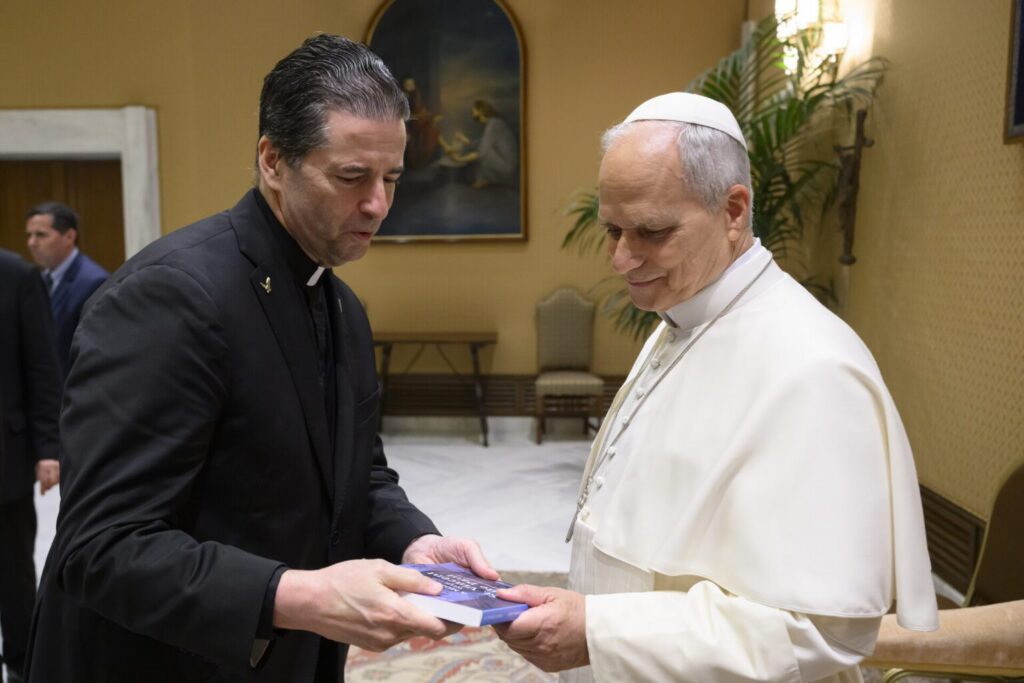
Earlier this summer, I had the privilege of participating in a Vatican seminar on the future of Catholic higher education, where university presidents from around the world gathered to reflect on the opportunities and challenges confronting our institutions. During the audience with Pope Leo XIV, I was able to present the Holy Father with a book on St. Vincent de Paul, founder of the Vincentian community who sponsor Niagara University.
Our conversation was brief, but it reinforced something I have come to believe even more deeply: the questions surrounding artificial intelligence are not merely technological. They are profoundly human.
That conviction was reinforced as I reflected on commencement season. At several university graduation ceremonies this spring in the United States, commencement speakers made artificial intelligence the centerpiece of their addresses. Each encouraged graduates to embrace a future shaped by AI and the extraordinary opportunities it presents.
Yet the reaction from many students was unexpectedly cautious.
Why would graduates standing on the threshold of their careers respond with hesitation, skepticism, and even opposition – rather than excitement?
I believe their reaction reflects a growing concern shared by many people. Artificial intelligence promises remarkable advances, but it also raises legitimate fears that technology may displace both blue- and white-collar workers, widen economic inequality, weaken human relationships, and leave many wondering where they fit in a rapidly changing world.
These concerns should neither be ignored nor allowed to paralyze us.
Artificial intelligence is here to stay.
The question before us is not whether AI will shape our future. It already is.
The real question is whether we will shape artificial intelligence according to the values that uphold human dignity, or whether we will simply allow technology to shape us.
That is the invitation Pope Leo XIV offers in his recent teaching on artificial intelligence.
Some critics have portrayed the pope’s reflections as resistance to innovation or a call for unnecessary regulation. I believe those critiques misunderstand both the document and the long tradition from which it emerges.
For more than 130 years, Catholic social teaching has engaged the defining challenges of every generation – from the Industrial Revolution to the promotion of workers’ rights and community development, to globalization, environmental stewardship, and now artificial intelligence. It has never rejected human ingenuity. Rather, it has insisted that economic, political, and technological progress always be measured by one enduring standard: the dignity of the human person.
Pope Leo continues that tradition.
His message is neither anti-technology nor anti-innovation.
It is profoundly focused on the centrality of humanity, the development of the community, and the common good.
Several principles emerge that can help all of us – not only Catholics – think more wisely about artificial intelligence.
Human dignity must remain at the center.
Every decision involving artificial intelligence should begin with a simple question: Does this help the human person flourish?
Technology enables us to accomplish extraordinary things with remarkable speed and efficiency. Those are genuine gifts.
But when efficiency becomes our highest value, we risk losing something essential. Human relationships weaken. Isolation grows. Fear and self-interest begin to replace compassion and community.
Pope Leo reminds us that technology must never lead us toward what Pope St. John Paul II called a “culture of death” – one in which people are valued primarily for what they produce rather than for who they are.
Artificial intelligence should always serve humanity, never replace it.
Artificial intelligence should strengthen solidarity.
Catholic social teaching reminds us that we are responsible for one another.
Pope Leo draws our attention to the story of the Tower of Babel in the Book of Genesis. Humanity sought to build a tower reaching heaven, seduced by its own power, intelligence, and domination. The result was not unity but division.
The lesson remains strikingly relevant today.
Technology possesses enormous power, but power alone cannot unite humanity.
Artificial intelligence can help expand educational opportunity, improve health care, strengthen communication, and solve complex global challenges. Used wisely, it can deepen solidarity by bringing people together in service of the common good.
Used poorly, it can isolate us, concentrate power in the hands of a few and deepen the divisions already present within society.
Technology should strengthen the bonds that unite us, not weaken them.
Artificial intelligence should advance justice.
Pope Leo also reminds us that technology should never become another instrument of domination.
Throughout history, new technologies have too often benefited those who already possess wealth and influence while leaving others behind.
Artificial intelligence presents us with a different opportunity.
It can become a powerful tool for expanding educational access, improving health care, creating economic and social opportunity, and strengthening communities that have too often been underserved.
These outcomes, however, are not automatic.
A just society requires that we make intentional choices.
Technology alone will never create a more just society. Human beings must choose to direct it toward the common good.
Artificial intelligence should become a tool for peace.
Perhaps Pope Leo’s most sobering reflection concerns warfare.
Human history reminds us that many technological breakthroughs eventually find their way onto the battlefield.
Artificial intelligence presents extraordinary capabilities, but it also carries extraordinary dangers when used to wage war more efficiently or distance humanity from the consequences of violence.
The Holy Father reminds us that our remarkable intelligence should not become a pathway toward mutual destruction.
Rather, these same technologies should help foster dialogue, strengthen diplomacy, build trust among nations, and promote peace.
As president of a Catholic and Vincentian university, I believe higher education has a unique responsibility in this moment.
Our task is not simply to prepare students to master emerging technologies. Our task is to prepare graduates who possess the wisdom, moral judgment and compassion necessary to use those technologies responsibly.
That has always been the mission of Catholic education.
The Vincentian tradition calls us to see Christ in every person, especially those who are poor, marginalized or forgotten. As artificial intelligence reshapes our economy and our society, we must continually ask: Who benefits? Who is left behind? How do we ensure that innovation lifts up the vulnerable rather than deepening existing inequalities?
Pope Leo ultimately presents humanity with two paths.
One resembles the Tower of Babel, where technological achievement becomes an end in itself, detached from humility, faith, and concern for others.
As a member of the Augustinian Catholic order, Pope Leo XIV refers to himself as a son of St. Augustine who called for the building of the city of God, a society built on justice, solidarity, peace, the common good, and love of neighbor.
Technology itself cannot choose between those paths. Only we can.
Artificial intelligence may prove to be one of the most powerful tools humanity has ever created.
Whether it becomes a force for greater human flourishing or greater human division will depend not on the intelligence of our machines, but on the wisdom of our hearts.
The Rev. James J. Maher, C.M., is a member of the Congregation of the Mission and has served as the 26th president of Niagara University since 2013. The university recently completed a $130 million capital campaign under his leadership and has been selected for two consecutive years by U.S. News & World Report as the “Best Value” of all 73 colleges in the north, a calculation that considers a school’s academic quality and the net cost of attendance.